By Jim Mills
“We have failed to make known to modern man the relevance of the Gospel.”
E. Stanley Jones

A QUEST FOR RELEVANCE
I am a true baby boomer, born in 1950 and birthed into a world where television in B/W was being introduced to the middle class families. My parents were dedicated Christians who taught us an appreciation for God’s word and prayed for us each day of our lives. I am grateful for my evangelical heritage in my family. My culture consisted of going to church, playing baseball, watching TV and attending school. Although I was raised in a good Christian family, still I stumbled as a teenager in my effort to live out the Christian life. In 1968, after an attempted suicide brought me face to face with death, I began my search to discover the reality of the God of the Bible. I longed to find a foundation in the Gospel that would bind me somehow to Heaven while my feet were still on this earth. Spiritual reality was my quest. Near the end of my studies at University, I stumbled until I fell at His feet and truly began my covenant pilgrimage as an ardent seeker of God and His truth.
From the very beginning, with guitar in hand, I lead youth groups, home group meetings and churches in worshipping God. I was not a music director; I could neither read nor write music. I was a worship leader, a new concept to the church in that hour. Two passions consumed my life and that was to know God and worship Him. Second to these was my desire to lead others to embrace the same ultimate ambition, to know God. Throughout my journey, there was an underlying quest that accompanied me. That quest was a passion for relevance.
“Those that hear not the music think the dancer mad.”
In the autumn of 1972, Fort Worth, Texas was my home. It was there I began my theological studies and preparation for my life of service. Two years later, I met my wife to be, Anne. We often say we met in prison. Actually, we met through the prison ministry of our home church in Dallas. In the summer of 1975, we were married and after the first year of marriage we stood at the door of our life’s adventure. In 1976, we landed in Munich, Germany full of expectations as we launched out into our missionary calling. The first three months we were plunged into a German language school. After those three grueling months of 4-8 hours a day of learning German, we were overwhelmed with the challenge of reaching a nation with the Gospel with our feeble language proficiency. Our new challenge: Europe, a nation rich with a Christian history and heritage appeared to be spiritually bankrupt. How do you reach a people who have Christian symbols literally on every corner? How could we make known the relevance of the Gospel to this continent that had all the appearances of being post-Christian?
In the first 9 years, we were privileged to serve with Youth with a Mission, an international interdenominational evangelistic youth endeavor. We lived in Schloss Hurlach, a beautiful 400-year-old castle in the heart of Bavaria that served as the headquarters of YWAM Germany. During most of the early years, we focused primarily on the arena of praise and worship. However, due to our weak German skills, we soon found other languages through which we could dialogue and disseminate the Good News: the language of the creative arts. However, with the exception of music, this was a major learning curve for me as I had no place for creativity or arts in my Christian thinking. Over these last 27 years, we have been privileged to compose choruses still sung by the German speaking church in Austria, Germany and Switzerland.
In the 1970s, while serving in Germany, other books dealing with culture, the arts and creativity began to take their place on my bookshelf alongside my collection of books on discipleship and worship. American writers such as Francis Schaefer and Frank Gaebelein and European authors like H.R. Rookmaaker and John Wilson became my mentors. Today, I thank God for voices in the wilderness, pioneer the often un-traversed territories of our cultures. You have heard the saying perhaps: “Those that hear not the music think the dancer mad.” I am grateful to know that I dance in a chorus line of men and women who hear the same music and I am comforted that I am not the only mad man in the house.
Through the years, I was frequently challenged to re-think my theological and philosophical presuppositions regarding creativity, art and culture. In my research and studies, I began to recognize and identify the primary issues which hindered us in our goal of conveying the relevance of the Gospel to our generation.
OUR FAILURE AND OUR CHALLENGE

The first step to overcoming any problem is first to recognize that we, in fact, have a problem. In 1993, a friend handed gave a book, “Roaring Lambs” by Bob Briner. Throughout his book, Bob challenges the church to be engaged and involved in our world. Whereas there is a movement in the church for the restoration of the arts, Bob identified the primary source of the churches’ inability to embrace themes like culture and the arts. Bob wrote:
“E. Stanley Jones . . . was asked to name the number one problem in the church. His quick reply was irrelevance. Not that the church was inherently irrelevant, but that Christians were failing to show in concrete ways and to tell in cogent understandable terms how the person of Christ is relevant to all of life in the twentieth century . . . Elton Trueblood,, a well-known Quaker expressed it another way: ‘It is hard to exaggerate the degree to which the modern church seems irrelevant to modern man’.”
This is a tragic indictment. The question we have to ask ourselves is, why is this the case? Also, what kind of disciples are we making through our evangelism? Are we harvesting a generation of believers who understand the connection of their faith and everyday life? The answer to these questions perhaps lies in our understanding of the Lordship of Christ. When we really understand Jesus to be “Lord of Life,” can we effectively begin to convey this reality to our world.
THE LORDSHIP OF CHRIST OVER ALL OF LIFE

In the early 1970s, renowned author and speaker, the late Francis Schaefer, in an interview, laid the foundation for the renaissance I experienced in my thinking. Schaefer was asked, “What do you think it will take to get the church to begin to accept and embrace the significance of the arts?” His answer was simply, “when we begin to take the Bible seriously . . . and when we realize that Jesus is the Lord of Life.” Since I was someone who took the Bible seriously and lived to proclaim Jesus as Lord, this simple statement began to turn my world ‘right side up,’ and established a foundational idea for my developing worldview. Francis Schaefer wrote in his brief theology of the arts, Art & the Bible:
“As evangelical Christians we have tended to relegate art to the very fringe of life. The rest of life we feel is more important. Despite our constant talk about the Lordship of Christ, we have narrowed its scope to a very small area of reality. We have misunderstood the concept of the Lordship of Christ over the whole of man . . . and have not taken to us the riches the Bible gives us for ourselves, for our lives and for our cultures.”
Reading Schaefer and other authors, I began to realize how I had compartmentalized my life into the spiritual and the non-spiritual. Through further investigation I was able to trace the origin of my tendency to Platonic and Gnostic ideas which were truly un-Biblical. I began to realize that serving God was more than direct evangelism, more than preaching powerful messages on Sunday mornings, more than blessed worship gatherings, more than my small narrow culture that I was living in. Jesus knew how all were to live: missionaries, preachers, moms, dads, kids, nurses, doctors, mechanics, painters and even dancers. My unconscious ‘sacred vs. secular’ theological dichotomy was exposed.
OUR WORLDVIEW: THE DOORWAY TO REACHING OUR WORLD

One of the answers to why we often fail in conveying the relevancy of the Gospel is because many in the church have a worldview which is often inconsistent with Biblical revelation. One of the resource books I keep on my desk is the English dictionary. Whereas I found definitions for World Series; world power; and even world soul; in my American College Dictionary, much to my surprise and dismay, there was not a definition given for the word worldview. Essentially, the idea behind this word is how we think about or look at or view life. This is a word that we definitely need to incorporate into our Christian vocabulary. This term is most commonly found in fields of study such as philosophy or sociology. Since the majority of our church members rarely move in these arenas, the concept is often not dealt with.
Most all of us would agree that there are primarily two ways we make God known to our world. The loudest way is through the way we live, that is through our character. Secondly we convey the reality of God through our verbal testimonies. However, another silent, yet incredibly loud message is the way we look at life. Actions speak louder than words, but the underlying worldview each of us possesses will also influence our actions and the way we live. As Francis Schaefer wrote, we the church, have often communicated a very narrow image of the sphere of Christ rule.

In 1996, a young Norwegian actor looked me directly in the eye and said, “Jim, you are the first Christian that told me that acting was not a sin.” Then he told me his story. Growing up as a young boy he was drawn to the theater. When Christian friends of his parents observed this, they warned his parents. “If your son is in the theater when Jesus returns, then he will be left behind.” This was not the first time that I had heard something like this from an artist. My response was simple, “Please forgive us for the way, we the church, have misrepresented the God of the Bible.” We must understand that God is the designer of life and the copyright holder of all that is. It is His desire that we learn how to live with the talents and gifts he has entrusted to us.
In all my meandering through church history, I have discovered much too often, similar stories to this young Norwegian actor. Christopher Parkening, in his book, The Spiritual Lives of Great Composers, related the following story of one of history’s great composers.
“In a small London house on Brook Street, a servant sighs with resignation as he arranges a tray full of food he assumes will not be eaten. For more than a week, he has faithfully continued to wait on his employer, an eccentric composer, who spends hour after hour isolated in his own room. Morning, noon, and evening the servant delivers appealing meals . . . and returns later to find the bowls . . . untouched. Once again, he steels himself to go through the same routine . . . as he swings open the door to the composer’s room, the servant stops in his tracks. The startled composer, tears streaming down his face, turns to his servant and cries out, ‘I did think I did see all Heaven before me, and the great God Himself.’ George Frideric Handel had just finished writing a movement which would take its place in history as the Hallelujah Chorus.”
Actually, Handel had just given his farewell concert, when he was handed a libretto from a friend based on the life of Christ. Intrigued by the Biblical text, the composer withdrew to his room absorbed in his work. In less than four weeks, he emerged with his 260-page manuscript that was first performed in Dublin for a charity. He titled the piece, Messiah.
Many do not realize that this brilliant masterpiece of Church music was initially condemned by the church of its day, as were most of his works up until then. It was to be 40 years before it was first sanctioned by the church leaders and performed as an expression of worship in the church. Why? This brilliant work of art was labeled as worldly and un-holy because it was written in the contemporary style of the theater of his day. Today, the Messiah has been exonerated as sacred and holy in the history of Christian music. In truth, it was holy when he wrote it, but the church stumbled over its narrow worldview for 40 years.
There is an urgent need to develop biblical thinking in the average member of the church. One of our Latvian dancers, while on tour recently in the USA, shared with a middle school before she performed a dance piece. Her statement says it all. “When I was a young girl I always dreamed of dancing and when I became a Christian, I concluded that if Christianity was true, then it was true to every area of life.”
VOCABULARY: A POTENTIAL CULTURE BARRIER
In the last 15 years, in the USA and around the world there has been a paradigm shift toward the arts. However, even in our new wave of Christians in the arts, we have developed our own terminology. We have thrown out words like entertainment and performance and replaced them with words like minister because we want to be biblically correct. Through our vocabulary, we can confuse those with whom we are attempting to dialogue. In truth through language, we reveal our worldview. As a young evangelical growing up in my church culture, I felt that I would never really be able to pray out loud. Why? Because I did not know how to speak the holy language that I heard spoken every Sunday. I supposed I would eventually learn, as I grew older in the Lord. I call that language Christianese and it sounded like King James Bible English. In the late 1960s, I had a personal “eureka experience” through discovering that I did not have to use King James English when I talked to God. However, I soon discovered that there were still other remnants of Christianese in the church’s vocabulary.

Along my path of discovery, I recognized that we create holy substitutes for worldly words. We have thrown out certain terms, which we fear misrepresent our motives. A few obvious examples are in our substitutes for words like entertainment and performance. The most common word employed, instead of these sinful polluted words, was the holy word, minister. How many times have I heard a well-meaning gifted Christian artist introduce his or her program in the following way, “Tonight I am not here to entertain you, but rather to minister to you.” I am persuaded that the artists introducing their program this way longed to give something of value that was not superficial. They concluded that the word entertain meant a superficial expression which was presented for its own sake.
Lord Kinnoul congratulated Handel on the excellent ‘entertainment,’ after his first London performance of Messiah. Handel replied, “My Lord, I should be sorry if I only entertain them. I wish to make them better.” Whereas I do understand and have the same passion in my own heart as Handel expressed, still I would like to suggest we take another look at the word, entertain. The word comes from two Latin words, the prefix ‘enter’ meaning ‘to enter’ and the suffix ‘tain’ meaning ‘to occupy.’ Is it not the objective of servant artists to enter into the world of their audience and occupy them with truth, worthy thoughts, and beauty from God’s perspective? In truth, a preacher on Sunday is entertaining us, in that he is occupying us through his public speaking skills with truth that potentially can change our lives.
Let us look at another word that is a taboo in our Christian vocabulary: performance. Often we avoid the word performance because we associate it with superficiality. For years I thought that those who did not know God performed and the redeemed ministered. However, a closer look at the definition of the word changed my mind. To perform means, according to The American College Dictionary, ‘to carry something out.’ The word performance is a noun that means an act where we employ our abilities in service to others.

When artists who are Christians employ their talents as public speakers or singers, then they are performing their task as servants. Malachi 3:18 reads, “So you will again distinguish between the righteous and the wicked, between the one who serves God and the one that does not.” There are only two kinds of human beings on earth: those who serve God and those who do not. God’s artists are servant artists. The difference between the redeemed and the un-reached should not be our terminology so much as the content of our lives. Through our terminology, we have distanced ourselves from our cultures to the degree that we cannot dialogue with them unless we first give them a dictionary of our holy terms. This only alienates and paralyzes us from reaching into our cultures with the relevance of the Gospel.
The central issue here is that we are looking to find adjectives and nouns, which license us to move in the arts without being worldly. The challenge is we do not need to change our vocabulary; rather we need to change our worldview. We must give meaning to our words by virtue of the way that we live. This is what the early disciples did in their lives and in their writings. They used the vocabulary common to their culture and redefined words by virtue of how they lived these words out.
FEAR OF THE WORLD’S INFLUENCE

Another reason why we have failed to convey the relevance of the Gospel is that we have pulled back from our cultures because of fear. We say we want to be true to the scriptures; however, perhaps our problem is that we are afraid of becoming worldly. Romans 12:2 reads, “And do not be conformed to this world, but be transformed . . .” It is important that we do not misinterpret what the word world means in this passage. The word world has to do “this age” and the inference is to a value system, or living outside of His rule. When we read in Colossians 3:2, “Set you mind on things above, not on the things that are on the earth,” how do we interpret this? What are things above? Is this referring to angels and clouds? This scripture means that we are to look at earth through His eyes and His perspectives. God, according to Psalm 8:3ff, has chosen to be mindful of man and His creation. We are to look with Him, value with Him, and be concerned with Him about His earth. Setting our minds on things above is to focus on what is on His mind.
We are so afraid that the world will influence us that we fail to influence our world. Dr. William Dryness in an article in the magazine ‘Cutting Edge’ wrote, “In the early 1900s we disengaged in the first half of the last century and withdrew from arts schools and the arts and then wondered why the arts were so secular. Twentieth Century Fox wrote Christian colleges in the 1930s and said, ‘Please send us writers! We want writers!’ The letter that went back said, ‘We would no more send people to you than we would send people to hell.’ That is what happened. Is it any wonder that the movies have become so bad? Whose fault is that? It’s partly ours.”
We are so afraid that the world will influence us that we fail to influence the world!
Throughout history, we the church have often abdicated our responsibility to be engaged in the real world for fear of becoming worldly. The word real and relevance are related. If we remove ourselves from the real world, then we make ourselves unable to relevantly convey the reality of God. Subsequently, we fail to fulfill our mandate to be the salt that preserves and nurtures our culture with His truth and values. We forsake our role of being light and do not “let our light shine before men that they would see our good works and glorify our Father who is in heaven.” (Matthew 5:16)
The key to a renaissance in the thinking and understanding of the church begins with the church leaders. It is our responsibility to gently introduce biblical and balanced cultural perspectives in our churches, not only through our words, but also creatively through the way we even organize our services. We must find ways to broaden our church culture so that His people can rest with being and living in the real world. We as leaders must begin to endorse not only those who are called to missions or Christian service, but also affirm those who plan “. . .to enter medicine or teaching, or journalism or writing, or plumbing or retailing, or any other world of work.” (Roaring Lambs, Bob Briner)
EMPOWERING THE NEXT GENERATION
 A friend of mine asked once, “your ministry is more youth oriented, more for teenagers, right?” My answer was simple. “Absolutely! Some people call them teenagers, we call them the future.” Each year, there are millions of new teenagers washing on the shores of young adulthood in the western world. These kids ride the wave of the most current trends. Sometimes it’s the teens that actually create the waves. “At the turn of this century, 1.7 billion people-more than a quarter of the world’s 6 billion people-were between the ages of 10 and 24, making this group the largest ever to enter adulthood.” (Population Reference Bureau- http://www.prb.org) That means 1 out of every 4 human beings is between 10 and 24 years of age. These are the people who are looking to find their place in this world. They are searching for their significance and seeking to find their destiny.
From the age of 10 years and up young people are not looking to dads, moms, and pastors as role models. They are looking to immolate artists and athletes. We fight with our kids to stop dressing like, acting like, and following bad role models, but we fail to give them any alternatives. It is in a teen’s DNA to look for a hero to pattern his life after. The artists and athletes in today’s world are their heroes. It is time that we, the church, endorse a new breed of heroes who know God and who can live and serve on the stage of life.

In his book, Roaring Lambs, Bob Briner sounded his message out loud and clear. “At the very least, the young people of the church should be made to see that their careers, whatever they may be, are just as vital and just as much a concern and mission of the church as those of the foreign missionaries the church supports.” The field is the world and every arena of life, every sphere of occupational involvement, is an opportunity to reveal the relevance of the Gospel.
The time to dream is now. We need young people who dream like Joseph. We need Daniels and Esthers with character and a sense of destiny. We need educators, scientists, creative writers, directors, actors, dancers, painters, poets, thinkers and philosophers, businessmen and businesswomen, counselors, politicians, architects, media specialists, engineers who realize they are called of God to make a difference in their culture. Thus we will demonstrate the reality of the Gospel: Redeemed man, living out His life as a servant of the Redeemer. Francis Schaefer says it most appropriately: “God made the whole of man . . . in Christ the whole of man is redeemed.”
WHAT’S ART GOT TO DO WITH IT?

The question arises, what does art, classical or contemporary, have to do with communicating the Gospel to this generation? The answer is simple. The arts are in fact the rhetoric of our societies. If we wish to be relevant then we need to speak the languages of the people that we wish to reach. Art is a relevant means through which we can communicate our worldview, our faith and our values. Today, we live in the most visually oriented generation of all time and people across the globe are listening with their eyes much more than with their ears. Jesus spoke to people in the language to which they were listening. He also communicated truth to the seeking heart through illustrations and parables. He knew that the seeking heart would search until they understood.
We must recognize that all art is a conduit, a translucent message revealing the values and the worldview of the art-maker. Art is unique gift to humanity; it enables us to search out, quest and express truth discovered. Art awakens, challenges, lures, builds up, tears down, heals, calms, stirs, soothes, rebukes and on and on it goes. Art is a gift to be celebrated, a tool to be employed, and a universe to be explored. Art is a discipline that requires work and it is a channel through which people are either enhanced or diminished. If anyone needs to grasp the significance of the world of the arts, it is the people of God.

In the summer of 1994, Anne and I took three professional dancers on tour through churches in the USA, two of whom danced for the Helsinki Ballet and one who was a freelance professional. That summer, we were in 11 services all across the mid-south and on the West Coast. One evening, we were in San Diego in an Assembly of God church. The missions’ pastor was a good friend of mine and he was willing to take a risk to have us come on the stage of the church on a Sunday evening. He introduced us a ministry from Europe who served utilizing the performing and fine arts in missions.
After the service, one encounter stands our in my memory. A gentleman came up whose eyes were swollen and red. He composed himself and began to tell me his story. He said, “When you were introduced this evening, I was irate. What on earth does dance have to do with the church? And how dare we use dance on the church platform.” He went on to say that when the first dance piece began, God overwhelmed and met Him so very deeply. He said he could not stop weeping throughout the evening. Remember that this was a man talking here. In his own words he exclaimed, “My vision of God was so enlarged. God can even speak through dance.” This man experienced a renaissance of his thinking and he will never be the same.
DEALING WITH RELEVANT ISSUES
In our mandate to convey the relevance of the Gospel to our generation we must not only be concerned about our worldview, our vocabulary and the arts, but we must address the heart of man. We must deal with relevant issues. For many years, I would address groups evangelistically with answers to questions that they were not asking. I had my thought-through answers and apologetics together. I was ready to reason with anyone until they would finally see the light.
It is in the place of prayer that compassion is born for a nation…
Since that time, I have learned a simple key to dealing with relevant issues. We must know the people we desire to reach. However, we must know more than their language, we must study their history, their heritage, their spiritual fault-lines, and the challenges they face. We must be aware of their offenses, their wounds, and their wars. The only way we can effectively dialogue and reach into their world is when our hearts are moved with compassion. It is then and then only that relevant strategies are birthed which will touch the heart of a people.
The final key is prayer. It is in this place that He can cultivate a listening ear to hear His whispers and secrets. It is also in this place that we will be enabled to hear the cries of a people and be prepared to reach the un-reached. It is in this place of prayer that compassion is born for a nation.
AN ‘INREACH’ STRATEGY: CREATIVE ARTS EUROPE

Whereas, there are a number of ways to relevantly convey the Gospel to this generation, Anne and I determined to discover ways to reach our culture through the language of creativity and the arts. A major breakthrough came in our work when we began to think ‘in-reach’ instead of ‘outreach’. ‘In-reach’ means penetrating culture barriers. In order to develop a successful ‘inreach strategy,’ we had to excavate and discover the highways of our Euro-cultures. Europe is filled with religious symbols however for the most part, it has become a post-Christian continent. Christianity is often perceived as a harmless, but social necessity. In our efforts to reach Europe, we had to find a way to circumvent these preconceived ideas concerning the Gospel.
Consistent with this idea of inreach, a key strategy we implemented was to register our organization based on our activities. We also named our mission according to our activities: Creative Arts Europe. Whereas CAE is a Christian mission, it is registered as an art and culture corporation. It states however, clearly in our articles of incorporation that “CAE fosters art in European culture from a Christian perspective based on the Gospel of Jesus Christ.” We had observed in Europe, that artists were free to express what ever they wished through their art, therefore, we concluded that we should also exercise this freedom. Because we are not registered as a religious organization, we are able to move freely in schools, theaters, hospitals, and other social institutions. Europe is longing to know spiritual reality and they are listening with their eyes!
Presently, Creative Arts Europe has 40 staff in eight European countries. We are essentially a network of artists and art lovers with a vision to fill Europe with art that reveals the reality God. Our staff consists of Christians from diverse occupational backgrounds, from stage performers to creative writers; from pastors to social workers that serve together on national and international art projects and events. Below is a concise definition of CAE’s mission along with our vision, philosophy, and strategies:
MISSION
CAE aims to permeate Euro-societies with art that resonates the reality of God and His truth.
VISION
– We see…
- A church and her artists engaged and relevantly disseminating the Gospel in European societies
- Christian art-makers inundating European cultures with art that proceeds from a Christian worldview
- A generation of Christian art-makers who embrace excellence in their lives and works
- Christian art-makers reaching the often alienated and unreached artists with the Gospel
- A new wave of creativity in the life and worship of the church
PHILOSOPHY
Art is God’s gift to humanity. All art reveals something of the values, worldview and life’s perspectives of its maker. Art that is pleasing to God emanates His perspectives, values and truths. Christian art is art produced by those who live to glorify the Lord of Life and to bring Him joy.
STRATEGIES
- TRAINING IN THE ARTS-
CAE develops training opportunities for the arts from a Christian worldview. - PRESENTING ART IN MOTION –
CAE fosters and presents examples of art in culture. - MENTORING ART MAKERS-
CAE mentors art-makers to embrace excellence in their lives and works.
TRAINING: STEWARDING OUR TALENTS IN OUR CHURCHES
 We co-sponsor arts training sessions each year in Germany, Holland, Belgium, Austria, Switzerland, and Finland. The aim of these training opportunities is to aid in the discovery and development of the creative giftings resident in a Christian’s life. Our teaching staff are professionally trained artists who are Christians and serve as role models for the next generation. During these training sessions, we focus on creativity, craftsmanship, character, and compassion.
Over the years, multitudes have attended these creative arts sessions and gratefully we have seen fruit of our labors. Some of the young participants that we encountered in our sessions years ago are now professional artists. Some have become pastors and leaders, and they are endorsing and affirming artists in their fellowships. Some are moms who are sending their children both to ballet school and also to Bible teaching each week. God gave the increase, and now what seems to have started as a seminar has evolved into a movement. Whereas it is true that over 80 % of the participants who have attended our workshops are not, nor will they ever be artists, they encounter a Biblical worldview and as a result will foster this mentality in their churches, small groups, and among leaders throughout Europe.
ART IN MOTION: MODELS TO BE IMMULATED
The second strategy we have is to create examples of art in motion. At one of our first seminars we met Loreen Fajgel, a seasoned dancer who had become a Christian. She was planning to leave her career as a professional dancer. During the seminar, she was ignited with a new vision to use her gift of dance to express her faith. Shortly thereafter, she and her husband, Michael, a professional actor, became staff of Creative Arts Europe Germany. In the early 1990s, Anne and I had begun to pull together a handful of professional dancers to tour Europe and in the USA. In 1996, we approached Loreen and asked if she would serve as the director of the company. To our delight Loreen accepted our invitation, and Xaris Dance Company was born.
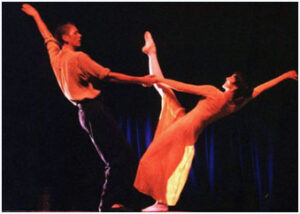
The Word “Xaris” is Greek for “gift” or “benefit”, and reflects one of the company’s primary aims – to raise money from the proceeds of the tours for various charities and humanitarian endeavors. All members of Xaris are committed Christians and the company also serves as a vehicle for them to create and perform new work. Xaris performs on cultural and church stages. Audiences are enhanced through excellent art that speaks of beauty and truth consistent with the Gospel and also
have an opportunity to be involved in elevating human suffering. Since 1996, Xaris has run 12 short-term tours raising thousands of dollars and awareness for Christian humanitarian aid endeavors. Up to this point, we have no underwriters or grants. Thus far the company exists on pure sacrifice. God sees their sacrifice and will honor them for it. You hear no complaining from any of the dancers and never from Loreen. She is a pioneer, and she knows her work is ultimately her worship.
 One dancer who just toured with Xaris wrote: “The tour was so incredible in every way. I already miss the spiritual fellowship we had in praying immediately when problems arose, sharing what we felt God was speaking to us, sharing our visions during prayer, and spontaneously singing songs of praise. Also, dance-wise, the choreography was challenging and the themes were meaningful and thought provoking. It is amazing how close you can become to a group of people you are with all day, every day for 5 weeks!” This precious dancer will never be the same.
Xaris is only one example of art in motion presenting the relevance of the Gospel to European cultures. Theater im Centrum in Kassel, Germany and Selah Repertoire Dance Theater of Riga, Latvia, are two initiatives of CAE where we are reaching into European culture. For more information see the websites: www.creativeartseurope.com, www.xarisdance.com, www.voicesfromtheground.com and www.theaterimcentrum.de
MENTORING ART MAKERS
Across Europe there are artists and art lovers who have found a new and deep well of inspiration through an encounter with the God of the Bible. These artists and creative people are concerned for the welfare of Europe and desire to speak creatively of their journey as believers in the Christ. CAE rallies these artists and art lovers together with a desire to encourage and aid them in finding their way and place as creative communicators in today’s contemporary Euro-societies.
We have encountered hundreds of these artists on my numerous travels throughout the continent. Honestly, sometimes I feel as though I have been the one mentored and trained. I cannot count the times when I have sat down on a flight or on a train next to composers, painters, writers, and musicians and on and on the list goes. I have met many artists who were Christians who were ready to give up and God allowed us to say, “Keep going, there is more.” We have attempted to understand them first as people and then as artists. We have read through, thought though and prayed through our worldview. We have invited them in our home for extended stays. We have dreamed and worked together till the early hours of the morning. We have encouraged churches to support their artists.
A parade of my dear friends, the artists, has been woven into the tapestry of our lives: dancers, poets, creative writers, painters, sculptors, actors, composers, musicians, photographers, sound engineers and on and on. My wife and I have prayed for them, wept with them and over them, fought for them, been attacked by them, counseled them, listened to them, and have been reduced to tears while savoring their artistic creations. We have talked them to sleep, laughed with them, been served by them, received encouragement from them, and we count them as some of our dearest and best friends for all eternity. Through their artistry we have learned so much about the beauty of God’s design, the depth of His heart and the richness of life.
My constant prayer is that artists know that they are no more and no less loved by our Lord than anyone else. In truth, they are no different, but just as unique as any individual who has ever walked the face of this earth. I long for them to enjoy the knowledge of their destiny in God and their role in making a difference in this world. I long for them to discover who God made them to be and be liberated from hiding behind their magnificent talents. I pray that they would live and breathe the joy of knowing, loving, and serving God. I pray that they would discover all He has prepared for those who love Him, “Which eye has not seen and ear has not heard, and which has not entered into the heart of man” (I Corinthians 2:9). Yes, even all the marvelous dreams that the Dreamer of all Dreams has dreamed over their lives. All this has made up my ‘school of the arts’ and I find I am still in that school.
PRESENT EVERYMAN COMPLETE IN CHRIST
Dear evangelists, worship leaders and pastors, it is time that we enlarge our vision of the Lordship of Christ. Let us seek to discover and proclaim the relevance of the Gospel. There is an entire generation waiting to be released to make a difference in this broken world. Let us not rob them of their destiny, rather let us endorse, affirm, and nurture those who are in our care. We must encourage them in the development and application of their gifts and talents in every arena of life. Let us not limit our endorsement to those who are called to full time Christian service. Seek out and call a new generation of servants, who with Godly character and passionate vision will move on the highways of culture and learn to speak the language of our time.
Allow creativity to flourish in your communities. Budget finances to this end. Allow the artists to serve and compensate them in an honorable way. Avoid conveying the idea that only when they use their gifts in the in the Sunday service or evangelism will they be serving God. Do not treat artists as the elite, as they are only as precious as any member of your church. Pray for artists and teach your congregations the value and significance of the role of arts in society. Remember that our talents are the tools to accomplish His purposes in each of our lives. Embrace Paul’s passion, which was to present “every man complete in Christ.” (I Colossians 1:28c) This applies not only in their character, but in the discovery and employment of their God entrusted talents. “God made the whole of man . . . in Christ the whole of man is redeemed.”[i]
Our challenge is to learn to relate to and dialogue effectively with the world we live in. May our response to the world and those we desire to reach be as John Wilson so appropriately expressed in his book, One of the Richest Gifts.
“Perhaps the starting point should be tears. Weep . . . for art that shows no craftsmanship and communicates no vision. Weep for our theaters where blasphemy and sexual license are mistaken for liberty; for our often violent and pornographic cinema; for cheap sensational literature; for poetry that has nothing to say; paintings revealing no created reality . . . We must weep for our lost culture, for the makers of that culture and the casualties that are all around us. We must mourn for the death, and apparent death of real art that, made with skill and imagination, can reveal a transcendent reality . . .The tears should lead to prayer. . .for those highly gifted that they will use their talents to enrich human life, bring truth and joy by opening our eyes and understanding . . . we should pray that God, the Giver of every good and perfect gift, will raise up Christian artists for our age . . . who are filled with the Spirit of God, with ability and intelligence, with knowledge and all craftsmanship.“

Jim Mills and his wife, Anne, are missionaries in Europe. They make their home at the Brussels Arts House, the headquarters for Creative Arts Europe, an international and interdenominational mission in Belgium. Jim has a BBA in Marketing-Advertising from University of Memphis and his Masters of Theology from Covenant Theological Seminary, Tallahassee, Florida, and was awarded a Doctorate of Ministries from Highland Theological University in Scotland and Reformed Theological Seminary in Jackson, Mississippi. Jim is a Bible teacher, recording artist, songwriter and accomplished vocalist. For more info on their work please visit the CAE website at www.creativeartseurope.com.
Resources & Recommended Reading
Art & the Bible, Francis Schaeffer, Inter-varsity Press, 1973.
The Christian, The Arts, and The Truth, Frank Gaebelein, Multnomah Press, 1985.
One of the Richest Gifts, John Wilson, The Handsel Press, 1981.
The Creative Gift, H.R. Rookmaaker, Cornerstone Books, 1981.
Modern Art and the Death of Culture, H.R. Rookmaaker, CrossWay Books, 1994.
The Spiritual Lives of Great Composers, Patrick Kavanaugh, Sparrow Press, 1992.
Roaring Lambs, Bob Briner, Zondervan Press, 1994.